


The Author
Neil Woodford
35 years managing funds · £33bn peak AUM at Invesco
This time last year, I wrote about the economic and political turbulence of the preceding four years and how the extraordinary policy settings of that period had left a challenging legacy.
As I looked ahead, I felt that the predominant theme of the coming twelve months would likely be the pace of monetary policy easing in the developed economies of the world.
And so it has proved in many ways, but what I didn't expect was the political heat and light that would be triggered by President Trump's “Liberation Day” announcements on tariffs.
In the end, though, the frenzy triggered by that shopping list of numbers, revealed in the Rose Garden in early April, dissipated quickly as it became clear that the worst-case scenario was nowhere near as damaging as first thought.
Indeed, as the year closes, there is a tentative mood of optimism that the upcoming meetings planned between Presidents Trump and Xi in 2026 might usher in a new period of trade détente between the two most powerful nations of the world.
If so, this would be a major positive for global trade and economic growth, as well as for financial markets, given that it would remove a major source of uncertainty.
Executive Summary
The macro backdrop for 2026 looks broadly supportive: easing inflation, falling rates, and less trade-policy uncertainty should help risk assets, with the UK still looking the most compelling major developed market.
I see the global macroeconomic environment as generally supportive of financial assets. Specifically, falling inflation and official interest rate cuts around the developed world, alongside reduced trade policy uncertainty, are the positives. There is also potential upside from a peace deal in Ukraine, but right now, given how many times this process has fallen through, I am not optimistic that acceptable terms will be found.
A growing political consensus in the US on issues like China, immigration, energy and industrial policy, including nuclear, critical minerals, biotech, quantum computing, defence technology, and re-shoring critical manufacturing, including semiconductors, pharmaceuticals and cars, will reduce policy uncertainty in relation to the equity market. This is a positive. Less clear is how attitudes to AI will evolve. Concerns about its impact on energy prices and employment are increasing amongst consumers, but strategically, it is clearly the number one priority for the government and the President, who has threatened executive orders to prevent states from slowing investment down.
Catalysed by what's happening in China and the US, I believe 2026 may be the year when political change in Europe starts to trigger a fundamental reappraisal of energy and industrial policy. Early signs of this may come through the relaxation of the timetable for phasing out ICE and hybrid vehicles and wider decarbonisation targets. Defence and the war in Ukraine will remain very high priorities.
If I am right and the EU starts to rethink its approach to these key issues, the UK will have to follow suit. First to go will be the UK's very aggressive and expensive energy and EV policy targets.
Lower inflation and interest rates will be good news for financial assets. In particular, I expect ten-year yields in the US and the UK to fall by at least 100bps.
In the US, valuation excess will constrain the S&P 500 and its leading constituents. Although I expect the index to rise in 2026, I believe it will be a modest single-digit increase. Opportunities in the market for better returns continue to exist in areas such as biotech and across the small- and midcap parts of the market.
The Eurozone index, the Euro Stoxx, should also register a modest gain in 2026, like the US, but will be constrained by valuation concerns and by low underlying economic growth in the Eurozone. As in the US, opportunities for better returns do exist, for example, in the semiconductor sector, where a cyclical recovery is well underway.
In China, a challenging macroeconomic backdrop will not be helpful for its equity market. Nevertheless, China's leading technology companies, whose valuations are considerably below US peers, still offer attractive upside, albeit less material than at the start of 2025.
The most attractive developed-economy equity market remains the UK, where economic growth will once again outperform consensus expectations, as will earnings in sectors exposed to the domestic economy. The market remains structurally undervalued, and the issues that have plagued the market for so long are now much less of a headwind. I expect it to deliver better returns than its peers once again in 2026 and would not be surprised to see a mid-teens percentage total return.
The Global Macro Outlook
3.1%
IMF Global Growth 2026
Down slightly from 3.2% in 2025
2.9%
OECD Global Growth 2026
Describes outlook as 'resilient'
2.8%
OECD Global Inflation 2026
Falling to 2.5% in 2027
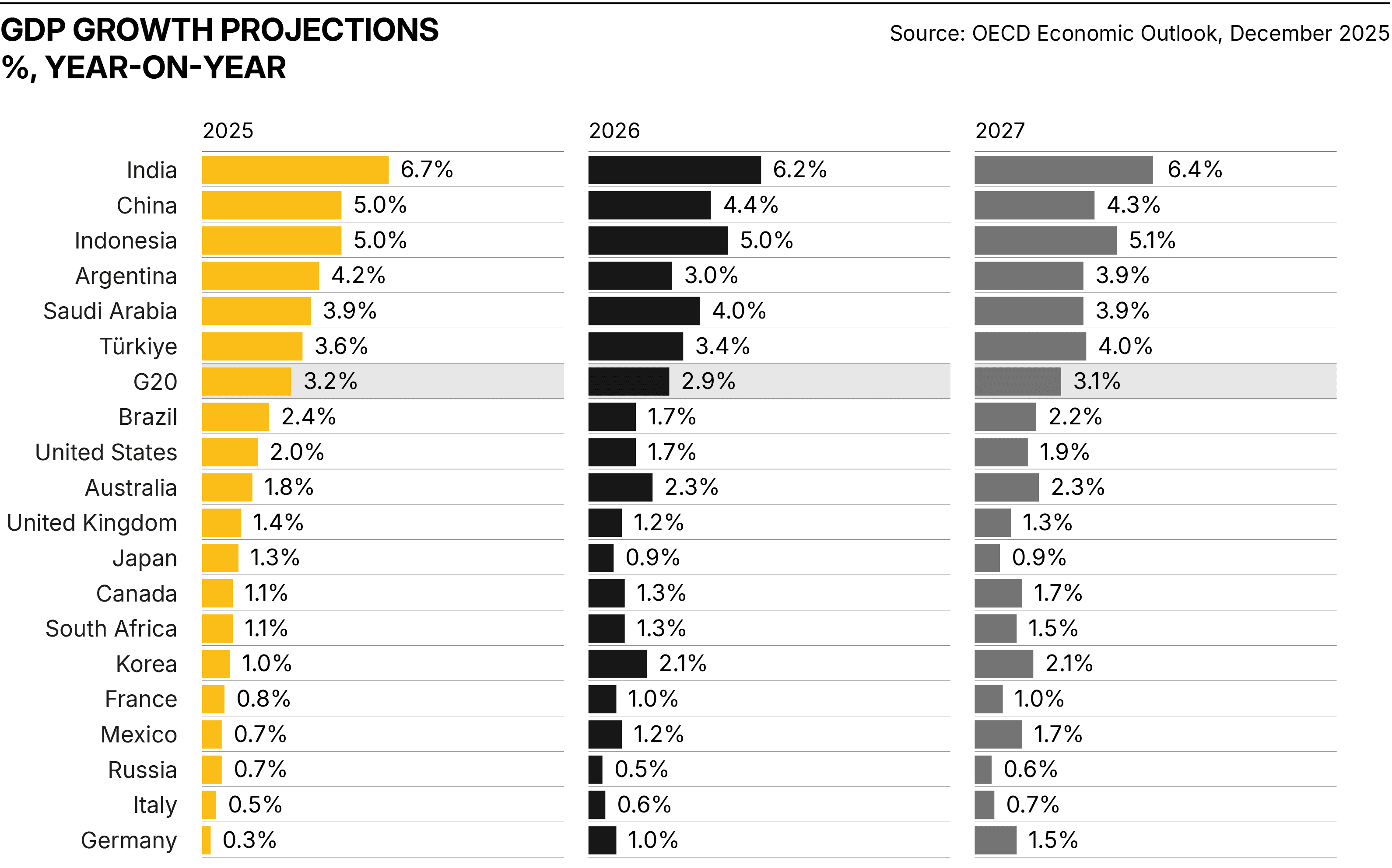
The IMF has issued a slightly downbeat forecast for 2026, which sees global growth slowing slightly from 3.2% this year to 3.1% next year. Interestingly, the OECD has upgraded its 2025 outcome from 2.9% to 3.2% which is pretty significant this late in the year, but has kept its relatively gloomy view from September of 2.9% growth in 2026.
The IMF sees emerging and developing economies (including China and India) slowing next year (4%, compared with 4.2% in 2025) and so-called “advanced” economies staying the same at 1.6%.
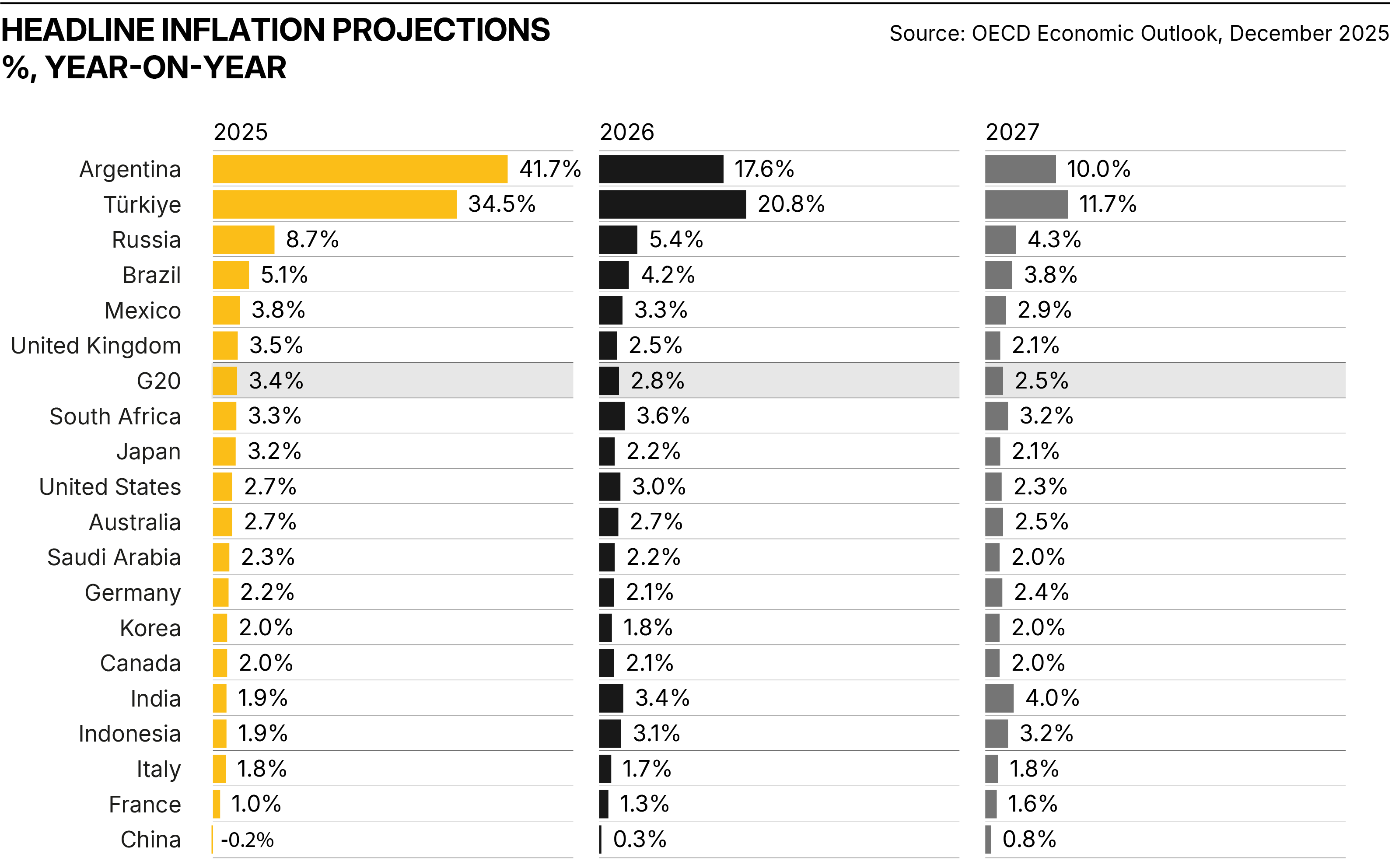
The OECD, in its latest update, is a bit more optimistic than in September (re the US) and sees global growth next year at 2.9%. Back in September, the OECD had a very low US growth estimate of 1.5%, but in its latest update, that has been upgraded to 1.7%, which is still below the IMF's view. The OECD has also upgraded its outlook for the UK economy, albeit that it is still wrong in my judgement, from 1% to 1.2%.
Strangely, the OECD, which has the lower growth forecast for 2026, describes the outlook as “resilient”, whilst the IMF, with the higher expectation, is downbeat in its narrative and describes the outlook as “dim”.
Of the two, I am inclined to agree with the IMF's numbers but not its narrative. The OECD's forecasts are too low, in my opinion, especially for the UK and US economies, but I agree with its description of the outlook as “resilient”.
In the IMF's narrative that accompanies its forecasts, it writes about its concerns in relation to escalating protectionist measures, ageing populations and skill shortages and ends with a brief comment about an abrupt market correction in the pricing of technology stocks, which to my mind almost guarantees no such correction will take place in 2026.
This summary says nothing about the AI industrial revolution and its increasing impact on all aspects of a modern economy. The OECD does briefly touch on this important aspect and suggests that upside risks could emerge from easing trade restrictions. I agree and am hopeful for the upcoming Xi/Trump meetings, and from faster advances in AI.
As for both organisations' China forecasts, the economy is slowing in 2026, according to the OECD, to 4.4% growth and, according to the IMF, to 4.2%. Confidence in the accuracy of macro data in China is not particularly high, but these forecasts do reflect the challenges policymakers confront with whole-economy deflation, falling property prices, and depressed consumption spending. These are not new problems, and although I broadly agree that growth will be lower in China in 2026, I am equally convinced that policymakers are determined to address these issues with more targeted fiscal stimulus measures, the scale of which should increase next year.
United States
~2%
2025 US Growth
Beat OECD forecast of 1.6%
3.5%
Fed Funds Rate
After three cuts in late 2025
3%
US Inflation (YE)
1% above Fed's target
This time last year, the OECD said it expected US growth of 1.6% in 2025, which, at the time, I said was too low. The IMF had a much higher forecast of 2.2% which I also thought would be beaten. The reality is that US growth looks very close to 2%, so my hunch was right relative to the OECD but a little too optimistic compared with the IMF's number. Nevertheless, the negative consensus that gripped economists mid-year, as the world adjusted to rapidly changing tariff announcements, was ultimately wrong. The tariffs turned out to be nowhere near as harmful as was initially feared, and the US economy has once again beaten its developed-economy peers.
The inflationary consequences of Trump's tariffs also turned out to be far less damaging than was first imagined. Although inflation in the US ended the year slightly higher than I would have expected at the start of the year, the inflation scare stories of the Spring never came to pass.
Better-than-expected inflation outcomes, combined with a relatively weak labour market, provided headroom for three Fed cuts in the last three meetings of the year, taking rates to 3.5%. Inflation finished the year at 3%, 1% above the Fed's target.

The US has been explicit: it does not intend to come second in the global AI race.
Peering into 2026, I am once again more optimistic than the rather gloomy OECD and surprisingly in line with the IMF's 2.1%. I expect inflation to fall in 2026, not least because, as the year progresses, the economy will annualise the tariff base effects.
I am also still of the view that oil prices will be weaker rather than stronger, which will help food prices in particular and help to bring down the overall CPI. My guess is that the Fed is of a similar view and is more concerned about the labour market than tariffs.
As inflation edges down to 2% over the course of the year, I expect bond yields to follow suit. The OECD and IMF's concerns about “sticky” inflation are, in my view, mistaken and broadly inconsistent with a weakening labour market and the productivity upside that will follow the broader adoption of AI technology.
I expect ten-year yields to fall towards the 3% level as the year unfolds, which will, in turn, support the equity market. That said, I still have concerns about the overall market's valuation. So, although I don't believe in the bubble-bursting narrative at all, I am not bullish on the S&P 500. The best opportunities in the US equity market, in my view, are still tucked away in neglected sectors like healthcare and in the mid- and small-cap areas of the market.
China
5%
2025 China Growth
In line with Neil's forecast
~4.3%
2026 Forecast
IMF & OECD consensus
~0%
Inflation
Whole-economy deflation persists
In 2025, the Chinese economy looks set to deliver the 5% growth I expected, ahead of the 4.5% growth the IMF and OECD were forecasting this time last year. Both the IMF and the OECD are forecasting slower growth in China in 2026 (to about 4.3%), and I broadly agree with them. Quite what the outturn will be is hard to be too precise about, not least because of the ongoing issues surrounding the reliability of the headline data. The same goes for inflation, which is expected to be about zero, close to the outcome in 2025.
The ongoing challenges in the Chinese domestic economy related to the property market, fierce price competition in industries with surplus capacity, and depressed household consumption will all be targeted again by policymakers in 2026 through specific fiscal measures and other interventions. Indeed, it appears that anti-involution policies may already be having some effect on the most virulent price competition in China.

Two Xi–Trump summits are pencilled in for 2026 — a potential upside risk to consensus China forecasts.
One risk factor that could be significantly reduced is the one related to trade and geopolitical friction with the US. The easing of tensions between the two countries in recent months and the fact that two face-to-face meetings between Presidents Xi and Trump are scheduled for 2026 suggest that there is further scope to reduce headwinds related to these concerns next year.
Ultimately, both countries are destined to remain economic and technological rivals for decades to come, but easing tensions in 2026 is a major upside. Whilst China remains seriously economically challenged by its intractable domestic issues, it is hard to see how growth can accelerate. However, I am confident that a relentless, determined policymaker approach to solving these issues will eventually yield positive results for the economy.
China's equity markets have had an outstanding year in 2025, and I believe there is scope for further strong performance next year, led again by the country's leading technology, AI, and battery tech companies. Valuations in these sectors, although higher than at the start of last year when many leading investment banks were saying China was uninvestible, can continue to expand, not least because many of these businesses will continue to demonstrate that they are genuine rivals to some of the US's leading and much more highly rated tech and AI companies.
Europe
~1%
EU Growth 2025
Core economies averaged just 0.5%
8 cuts
ECB Rate Cuts since Jun 2024
Rates now about as low as they can go
Last year, I suggested that the EU would continue to face challenging economic and political issues, structural rigidities, excessive regulation, and a stifling bureaucracy, which would be hard to overcome and would lead to lower growth than that delivered by its developed-economy peers.
Broadly, this played out as I had expected, particularly in the core countries of Germany, France and Italy. More peripheral but still economically significant countries like Poland and Spain delivered much better growth outcomes, which appear to have lifted the EU average to about 1% (I had forecast about 0.7%). In contrast, the core three will deliver an average of about 0.5% growth.
Peering into 2026, I believe that the EU economy will continue to grapple with many of the same problems, including its challenging energy and EV policies, which are causing major headaches for Europe's energy-intensive and automotive industries, which are critical, especially for the German and Italian economies. Chinese industrial competition will also continue to pose many challenges for these industries.
Clearly, these problems will not be easily overcome and, in my opinion, ultimately will require a fundamental shift in political and economic priorities if they are to be resolved in a way that will liberate higher growth in the region.

The ECB has cut rates eight times since 2024 — they are now about as low as they can go.
Finally, the ongoing war in Ukraine continues to pose an existential threat to Europe both economically and politically. The dramatic shift in the US's approach to NATO and its effective historic commitment to fund Europe's defence also has profound implications for the region, which are yet to play out fully.
In 2026, France's political and budgetary crisis will continue to rumble on and may eventually lead to significant and potentially disruptive elections. The headwinds highlighted above will, of course, continue to affect growth across the region, so once again, my guess is that growth in the EU in 2026 will lag that in the US and the UK.
I have mixed feelings about EU equity markets. On the one hand, the low growth scenario is a major challenge, and after a period of aggressive ECB rate cuts (it has cut rates eight times since June 2024), there may be less support from looser monetary policy in 2026. In general terms, EU equity markets are also less appealing from a valuation perspective than the UK. That said, I can still find some very interesting specific situations across the region, just as in the US, where there appears to be significant further upside.
For me, the summary in the EU is one of missed opportunities. Higher growth could be promoted by less regulation and more sane energy and EV policies (interest rates are about as low as they can go at 2%), but the political climate has yet to change sufficiently for this to be a realistic prospect. So, in the meantime, it looks to me as if the EU will continue to experience subpar growth and a challenging political backdrop, especially in France and, potentially, in Germany as well, which also faces state elections next year.
United Kingdom
~1.5%
2025 UK Growth
Better than OBR's 1% forecast
2%
2026 Forecast
Neil's view vs OBR's 1.4%
12.4x
All Share PE
2026 forward PE ratio
3.6%
Dividend Yield
On 2x+ dividend cover
This time last year, I wrote that I expected the UK economy would once again outperform a lazy, doom-laden consensus. I was right, but too optimistic. I said I expected 2% growth, and the outcome looks likely to be close to 1.5%, which is clearly much better than our European peers and significantly better than the OBR's March forecast of 1%, for example, but not as good as I had hoped.
The headwinds this year, in the form of the legacy of Rachael Reeves' first budget and the elevated inflation it led to, were factors I underestimated. As a consequence of that, the MPC was slower to reduce interest rates than I had expected, and so the scale of monetary stimulus I expected through the early part of the year didn't come through. In fact, the first rate cut came in May, with the second in August, and I believe we will see another at the December MPC meeting.
Although I ended up being too optimistic, my hunch is that the benefit of lower interest rates is only deferred, not cancelled. Consequently, I am pretty confident that lower interest rates, which I expect to be cut twice more in the first half of next year, will have a significantly positive impact on growth in 2026. That's why I am very confident that growth will accelerate in 2026 to 2% from this year's 1.5%, driven by the impact of lower interest rates on household saving and spending behaviour and by ongoing strong growth in government and business investment spending. Inexplicably, both the MPC and the OBR have forecast that growth will slow in 2026. The MPC is expecting 1.2% and the OBR 1.4%. I am really struggling to understand this. Once again, I think both will be very wrong, and both will have to upgrade significantly as the year progresses.

“The UK remains one of the cheapest equity markets in the developed world.”
Inflation in the UK was driven higher by the impact of Rachael Reeves' first budget. It increased employers' NI, which in turn increased the costs of employing people and, amongst other things, led to higher food prices. It also explicitly added to inflation through other direct measures, including increases in vehicle excise duty, private school fees, bus fares, the minimum wage, and air passenger duty, as well as other excise duty increases on vapes and tobacco. As a result of these measures and higher utility bills, inflation rose in the first half of the year and peaked at 3.8% in September. It has now started falling, and that descent will accelerate next year, and I suspect inflation will be close to the MPC's 2% target by the mid-point of the year.
Interestingly, the UK equity market has had a very good year and so far, with a gain of over 18%, it is beating the Euro Stoxx and the S&P 500, as I forecast that it would — not by much but significant for an index which has arguably been in the doldrums for over two decades. UK equity valuations remain depressed relative to both history and peers, and given the improving economic backdrop, I see no reason why 2026 will not be another year of good performance, which should, once again, surpass the performance of the S&P and the Euro Stoxx. Domestic equities, in particular, those most exposed to the slings and arrows of the domestic economy, are the ones I expect will again lead the market higher.
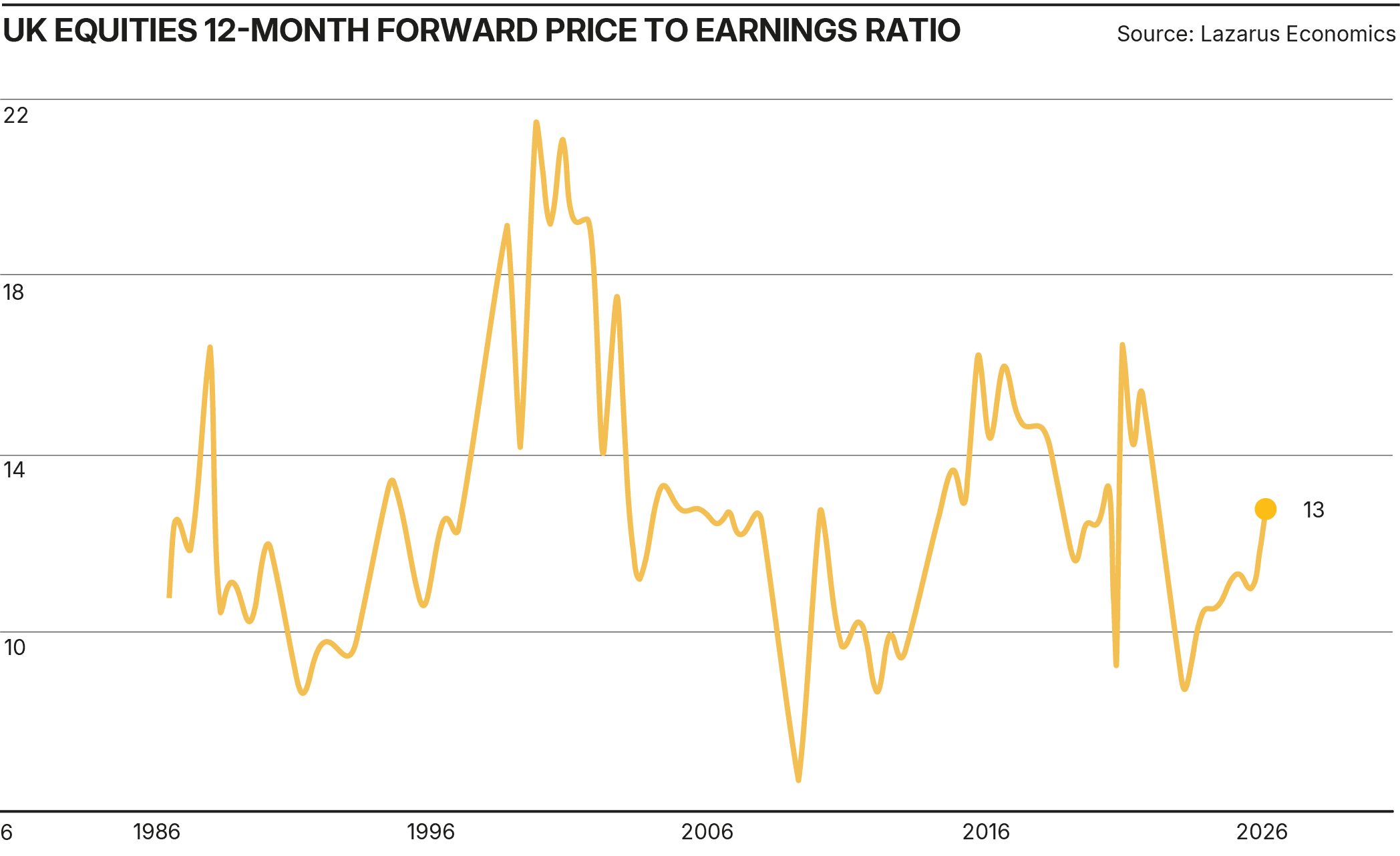
The summary UK equity market numbers are revealing. The All Share index sits on a 2026 PE of 12.4x, yields over 3.6% on more than 2x dividend cover, and has a ROE of 15.6%. The price-to-book ratio of 1.9x suggests a cost of equity of 8.2%, or, put another way, an expected return of 8.2%.
All sorts of longer-term data series show different things by way of comparison. For example, over the twenty years to 2023, the average return from the All Share Index was a bit over 6%, over fifty years, the number is about 5.5%. Even more interestingly, according to McKinsey, the long-term ROE of the UK equity market has been close to 13%. Over the long term, the US ROE is not much different at 13.7% but I suspect that, given the preponderance of the Mag7 and the high returns inherent in these businesses, this return will have moved up in recent years as it has in the UK.
In summary, what you now get from the UK equity market is a more profitable community of businesses (ROE of 15.6%) trading on a historically low rating (outside of crises) with an expected return (cost of equity of 8.2%) significantly above the long-term average.
Finally, by way of comparison, UK ten-year yields are currently just above 4.4%. Given what I expect to happen to UK inflation and base rates over the next twelve months, I expect this ten-year yield will fall to about 3.5% and possibly below this level by the middle of next year. This should also provide a very supportive backdrop for the UK equity market.
Financial Markets & Outlook
After a year dominated by tariffs, trade tension, escalating and de-escalating military conflicts and the all-encompassing AI industrial revolution, financial markets might dare to look forward to a slightly less hectic 2026. My guess, though, is that 2026 will be as volatile as 2025 but in different ways. Once again, central bank decisions on interest rates will be a very powerful influence on the direction of financial markets, and Trump's inherent volatility will play its part, I am sure. Ongoing trade tension de-escalation between China and the US will be a significant influence, I hope, as will a potential peace settlement in Ukraine, which, if achieved, will have an important impact on energy prices. We will also confront important elections, not least midterms in the US in November.
Underlying all of this will be the influence of falling government bond yields in the US and the UK, the twists and turns in the race to achieve AI dominance geographically between the US and China, and the race to achieve AGI.
Other tech subjects I expect to play out include more M&A in the pharma sector as the 2030 patent cliff approaches, and increased attention to quantum computing and fusion energy breakthroughs.
Fundamentally, though, this macro environment is generally supportive for financial markets, both fixed interest and equity. For obvious valuation reasons, I continue to believe that the UK equity market offers the most attractive potential upside among the major equity indices, but, as I say, this is a generally supportive environment based on what is forecastable now as we approach the end of 2025.

This macro environment is generally supportive for financial markets, both fixed interest and equity.
Watch & Listen
On this week's podcast, we discussed Neil's global economic outlook plus how he would approach constructing an investment strategy for 2026.
Download
Get the full report as a PDF
Save it, share it, or read it offline. The complete Global Economic Outlook 2026 in one document.
Download PDF