

GDP data: here we go again!
Yesterday, the ONS published April's GDP growth number. Although the outcome was better than the consensus expected, it has predictably led to a chorus of negative press.

Neil Woodford
W4.0
GDP data: here we go again!
Neil Woodford
W4.0
Yesterday, the ONS published April's GDP growth number. Although the outcome was better than the consensus expected, it has predictably led to a chorus of negative press.
Yesterday, the ONS published April's GDP growth number. Although the outcome was better than the consensus had expected, at flat rather than a decline of 0.1%, the result has predictably led to a chorus of negative press, which tends to be the norm these days, but is inevitable given the general election campaign is in full swing.
We already knew that retail sales had been relatively weak because of April's disappointing weather (155% of normal rainfall), but clearly, it also had an impact on construction output, which was down 3.3%.
Bloomberg described the data as showing that the UK economic recovery ground to a halt and added that the highest interest rates in 16 years continue to weigh down on the finances of businesses and consumers. Hailey Low from the National Institute of Economic and Social Research adds that the UK remains fragile on its route to a sustained economic recovery and finishes with the following, "The broader perspective remains an economy grappling with stagnation".
If you are a regular reader of Woodford Views, you will know that the UK economy in the first quarter of 2024 delivered growth well ahead of the consensus expectation and miles ahead of the Bank of England's forecast. Indeed, it looks to me as if the UK is not only growing faster than its near-European peers but is also now growing more quickly than the US economy. (The US grew by 0.4% in Q1, which is an annualised rate of 1.3%) By definition, if the UK is stagnant, so are France, Germany, Italy and Japan, whose economy shrank in Q1, and the US.
By way of background, NIESR is forecasting UK growth of 0.9% for the whole of 2024. Interestingly, after March's better-than-expected data, NIESR upgraded their forecast for Q1 growth and commented, "GDP grew by 0.6% in the first quarter of 2024 relative to the previous three-month period, a stronger than expected growth compared to our previous forecast last month."
So in the space of about four weeks, according to NIESR, a highly regarded economic research institute, the UK has gone from "stronger than expected growth" to "stagnation".
This sort of consensual economic commentary is not at all helpful, but unfortunately, it is all too common. The reality is that the UK's economic recovery from last year's disappointing performance is gaining momentum, as you can see in the simple chart below.
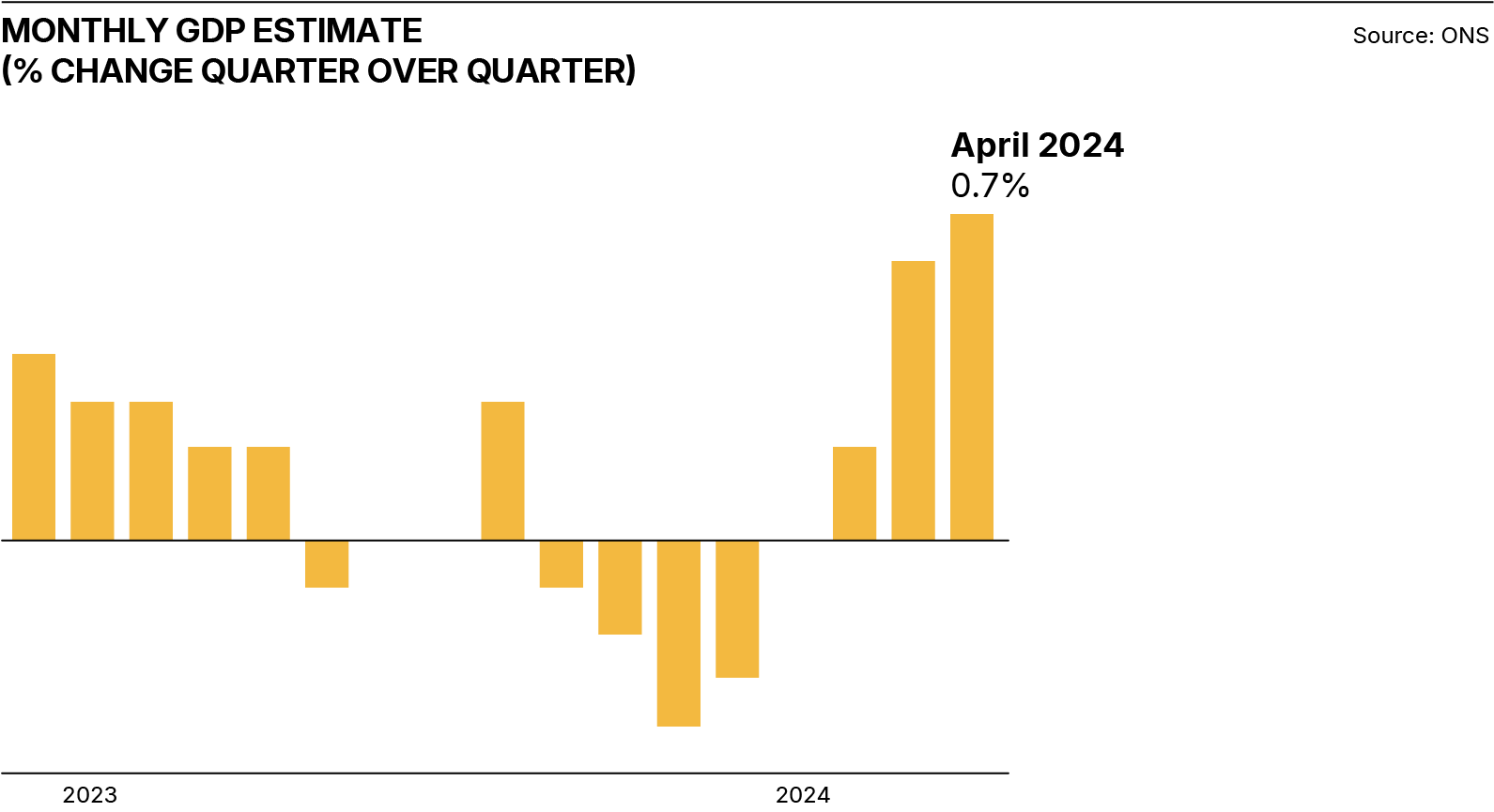
UK economic growth quarter on quarter is now at 0.7%. That is annualised growth well above 2%. To be clear, this is a rolling three-month measure of growth, so the latest numbers are February, March, and April's growth over November, December, and January's numbers. So far from grinding to a halt or stagnation, the UK economic recovery is accelerating despite the wettest, miserable April weather I can remember! Interestingly, the ONS points out that services output (the largest component of the economy) grew by 0.2% in April, its fourth consecutive month of growth and also grew by 0.9% in the three months to April.
I apologise for returning to this subject again so quickly. I hope you can see why I do. The consensus commentary on the UK economy continues to be eminently forgettable. I promised a different narrative based on facts and data, and based on those facts, I hope you can see that the UK economy's performance is continuing to improve. If we eventually see some decent summer weather, it may even get better.
Related reading

How not to run an economy
Why this government's fiscal incontinence has left it unable to fund defence, and what a real growth revolution would look like.
Read more
The demographic landslide: why birth rates are collapsing everywhere
The UN keeps cutting its population forecasts – and the latest fertility data say it still isn't pessimistic enough. Neil Woodford on the collapse almost no one is pricing in, and the device that may be driving it.
Read more
A dose of reality
As policymakers warn of doom, the data tells a different story. Neil takes apart the MPC, the IMF and the Chancellor in light of an April inflation print that undercuts the consensus case for caution.
Read moreStart investing with transparency
Access our full research, strategy insights, and real-time portfolio visibility.